
For senior engineers and tech leads who build platforms
Build the platform behind an AI-native business.
An eight-week build-along for senior engineers and tech leads: multi-tenant data, micro-frontends, cross-module workflows, and AI agents with real guardrails.
What you leave with
You will leave with a working mini-platform, a tenancy model, an integration map, an agent with approvals and audit, and a deployment pipeline you can defend.
8 weeks
Build-along
24 hours
Live contact
15 max
Cohort cap
Starter repo
Hands-on labs
Admissions
Get the course guide & apply
Tell us where you are and what you are trying to move forward. Every note is read personally. No lists, no sequence, no pressure.
Prefer the full working syllabus? Use the private curriculum request in the curriculum section. It is not published or indexed.
Engineering standards grounded in 15+ years at
Who this is for
Built for people who own the outcome.
This is not a survey course. The work assumes you have real decisions to make and can bring a current system, team, or delivery problem to the labs.
A fit if you are…
- Senior engineers and tech leads who want to build platform architecture, not just consume it.
- Platform engineers responsible for shared shells, design systems, and module boundaries.
- Technical founders who want to understand the system they are funding.
- Engineering leads moving from a single app to a multi-module product.
Not a fit if you want…
- Beginners who have not shipped a React or Node.js application.
- People looking for a prompt-engineering course or a no-code AI tool tutorial.
- Teams that want a code audit or a done-for-you platform build.
What changes
What you will be able to do afterwards.
Stand up a shell host and two independently deployable remote modules.
Implement three-tier tenancy, row-level security, and request-context propagation.
Design API and event contracts that survive independent module teams.
Add an AI agent with tool calls, approval gates, audit, and an evaluation plan.
Model entitlements, plans, and feature flags without hard-coding customer logic.
Ship through a CI/CD pipeline with tests, security gates, and rollback.
Curriculum
The work, week by week.
Each session produces a decision, a design, or a working slice. The capstone connects them into one architecture you can defend.
The private version includes weekly exercises, lab briefs, assessment rubrics, and the capstone checklist. It is not published or indexed.
Week 1Platform map and domain boundariesArtifact: Platform map + repository topology decision
Start with the business, not the framework. You will map the product into domains, choose the repo topology, and define what the platform owns versus what modules own.
Week 2Tenancy, identity, and data isolationArtifact: Tenancy schema + isolation test suite
Build the trust layer first. You will implement a three-tier hierarchy and prove that one tenant cannot read another tenant's data.
Week 3The micro-frontend shellArtifact: Shell host + two remote modules
Build a host that can load, route, and isolate independently deployed modules without rebuilding the whole product.
Week 4Contracts, events, and workflowsArtifact: API/event contract pack + workflow slice
Connect modules without turning the platform into a distributed monolith. You will specify contracts and implement one reliable cross-module workflow.
Week 5AI agents in the productArtifact: Agent workflow + evaluation pack
Add an agent that does real work inside the platform — with tool permissions, approval gates, audit, and an evaluation harness.
Week 6Entitlements, onboarding, and pricingArtifact: Entitlement model + onboarding flow
Make the platform commercially real. You will model plans, module enablement, feature flags, usage, and tenant onboarding.
Week 7Delivery, observability, and costArtifact: Deployment pipeline + operations dashboard
A platform is only real when it can be deployed, observed, and afforded. You will wire the pipeline and the operating dashboard.
Week 8Capstone and architecture defenseArtifact: Working capstone + defended architecture pack
Extend the starter platform with a new module and defend the decisions: boundaries, tenancy, contracts, agent safety, and delivery.
Production proof
A platform, not a slide deck
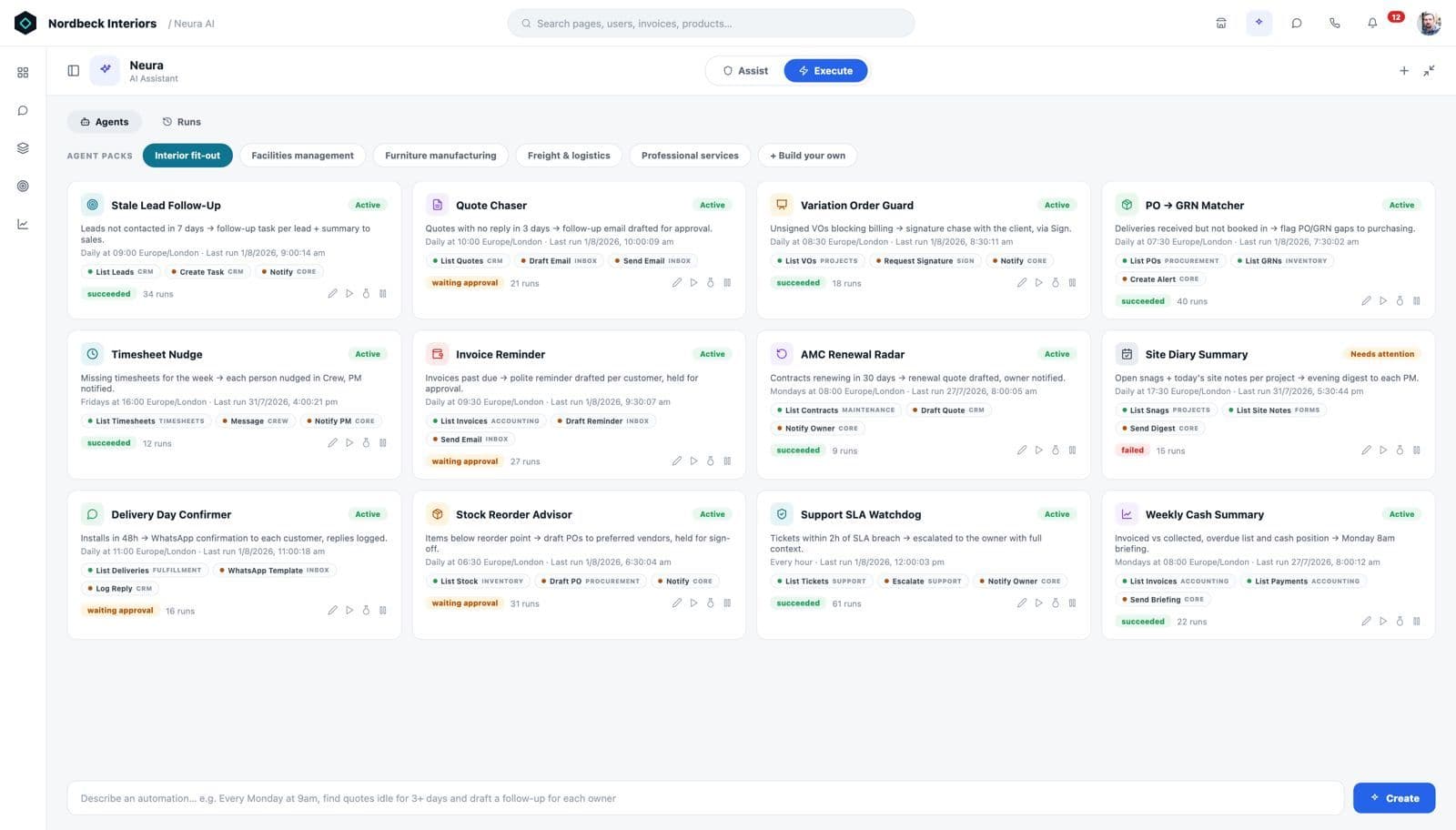
The starter platform and case studies are extracted from Neonbee, a multi-tenant enterprise platform with 20+ modules, 10+ micro-frontends, and roughly 60 deployable services. You will see the same concerns in the labs: tenant isolation, module entitlements, cross-module events, AI approvals, and a delivery pipeline that can roll back.
The case used in the labs
The capstone mirrors the Neonbee architecture: a shell, independent modules, a shared context package, an event bus, and an AI agent with approval and audit — reduced to a teachable starter repo.
20+
Business modules
10+
Micro-frontends
~60
Deployable services
3-tier
Tenancy model
Instructor: Praveen VR
Ex-Dell Principal Engineer · Nokia & Alcatel-Lucent R&D · Founder, Moonhive & Neonbee AI
What you leave with
Artifacts, not notes.
Every deliverable is built during the program and reviewed. You can take it into a real review, a planning cycle, or a hiring conversation.
1
Working mini-platform
A shell host, two remote modules, tenancy, one workflow, and one AI agent.
2
Architecture pack
Platform map, boundary decisions, and a written trade-off record for each major choice.
3
Tenancy test suite
Automated checks that prove tenant isolation and catch context leaks.
4
API and event contract pack
Versioned contracts, ownership rules, and a reliable cross-module workflow.
5
Agent evaluation pack
Test cases, approval flows, audit requirements, and cost guardrails.
6
Deployment pipeline
CI/CD with verification gates, health checks, blue/green, and rollback.
Format & investment
How it runs.
Training-only, by design
No code access, no PR reviews, no repository audit, no NDA, and no done-for-you implementation. You learn the pattern and build the artifact; your team keeps ownership.
Cohort pricing
AI-Native Platform Engineering
Request the current cohort sheet for tuition, starter-repo access, and the next start date. Seats are capped so every capstone gets a review.
Live instruction and review directly with Praveen VR.
All templates, artifacts, and session materials.
Employer sponsorship brief and itemised invoice.
Questions
Clear answers before you apply.
Still unsure? Send a note through the form and Praveen will give you a straight answer.
How much coding experience do I need?
You should be comfortable with React, Node.js or a similar backend, and relational databases. The labs are guided, but they assume you can read and modify a real codebase.
Do I need to know Module Federation or NestJS?
No. The starter repo includes a working shell and module setup. You will learn the concepts as you extend it. Familiarity with React and TypeScript is enough to start.
Is this a course about prompt engineering?
No. Prompting is a small part. The course is about the platform that makes AI useful and safe: tenancy, permissions, tool access, approvals, audit, evaluation, and delivery.
Do you access our codebase?
No. You build in the provided starter repo or your own sandbox. This is training-only; we do not review production code, take repository access, or sign an NDA.
Can I take this after the Technical Leadership cohort?
Yes. The leadership cohort teaches how to decide; this cohort teaches how to build. They share case studies but have different outcomes, so they work well as a sequence.
What happens if I fall behind?
Every week has a recorded walkthrough and a checkpoint. The capstone is designed in slices, so you can catch up without rebuilding everything at the end.
Next step
Make the next step count.
Applications are reviewed personally. If the fit is right, you will get a short alignment call and a clear next step. If not, we will tell you.