
For senior engineers moving into Team Lead or Architect roles
From senior engineer to the architect who owns the decisions.
A six-week cohort for senior engineers and tech leads who want to make, defend, and land architecture decisions — without waiting for a title change.
What you leave with
You will leave with a decision framework, a defended architecture blueprint, and the language to lead technical decisions in front of engineers, product leaders, and executives.
6 weeks
Live cohort
18 hours
Live contact
15 max
Cohort cap
No code
Case-study labs
Admissions
Get the course guide & apply
Tell us where you are and what you are trying to move forward. Every note is read personally. No lists, no sequence, no pressure.
Prefer the full working syllabus? Use the private curriculum request in the curriculum section. It is not published or indexed.
Engineering standards grounded in 15+ years at
Who this is for
Built for people who own the outcome.
This is not a survey course. The work assumes you have real decisions to make and can bring a current system, team, or delivery problem to the labs.
A fit if you are…
- Senior engineers with 5+ years of experience who want to move into Team Lead, Staff, or Architect roles.
- Tech leads who already own delivery but have never been taught how to own architecture.
- Engineering managers moving closer to system design and technical decision-making.
- Staff/Principal candidates who need to defend trade-offs, not just produce diagrams.
Not a fit if you want…
- Junior developers looking for a coding bootcamp or framework tutorial.
- Engineers who want someone else to design their system for them.
- Teams looking for a code audit, PR review, or done-for-you implementation.
What changes
What you will be able to do afterwards.
Turn a business goal into module boundaries, data ownership, and a sequenced architecture roadmap.
Choose between monolith, services, and micro-frontends with explicit trade-offs — and know when not to split.
Design multi-tenant data isolation, permissions, and audit that survive a real architecture review.
Write decision records and defend them to a mock architecture board and a promotion panel.
Lead technical decisions without relying on authority, consensus, or a perfect diagram.
Curriculum
The work, week by week.
Each session produces a decision, a design, or a working slice. The capstone connects them into one architecture you can defend.
The private version includes weekly exercises, lab briefs, assessment rubrics, and the capstone checklist. It is not published or indexed.
Week 1The architect's mandateArtifact: Decision-rights map + architecture review agenda
What actually changes when you move from producing code to owning decisions. You will map decision rights, stakeholders, constraints, and the review cadence that makes architecture stick.
Week 2Business-first architectureArtifact: Business systems map + build/buy recommendation
Architecture is an economic system before it is a technical one. You will learn to read revenue, work, and data flows, then translate them into boundaries and sequencing.
Week 3Data, tenancy, and trustArtifact: Tenancy decision record + isolation test plan
Multi-tenancy is where architecture reviews expose whether a design is real. You will work through isolation models, row-level security, context propagation, permissions, and audit.
Week 4Module boundaries and integrationArtifact: Module boundary map + integration contract
Most platform problems are boundary problems. You will compare modular monoliths, services, events, and workflows — and learn to specify contracts that survive independent teams.
Week 5Platform and frontend topologyArtifact: Platform topology + frontend ownership model
Micro-frontends are an organisational design decision. You will learn what they buy, what they cost, and how to run independent deploys without fragmenting the product.
Week 6AI in the architecture — and the defenseArtifact: Capstone architecture blueprint + defense feedback
Where agents belong, where they do not, and what an architecture must provide for AI to be safe. The cohort closes with a live architecture defense against a mock review board.
Production proof
The architecture behind the teaching
Every framework in this cohort comes from systems that shipped: a multi-tenant enterprise platform, a 100,000-device IoT fleet, an industrial ERP, and enterprise portal work at Dell. You are not learning a diagram from a textbook — you are learning how decisions were made, what failed, and what survived production.
The case used in the labs
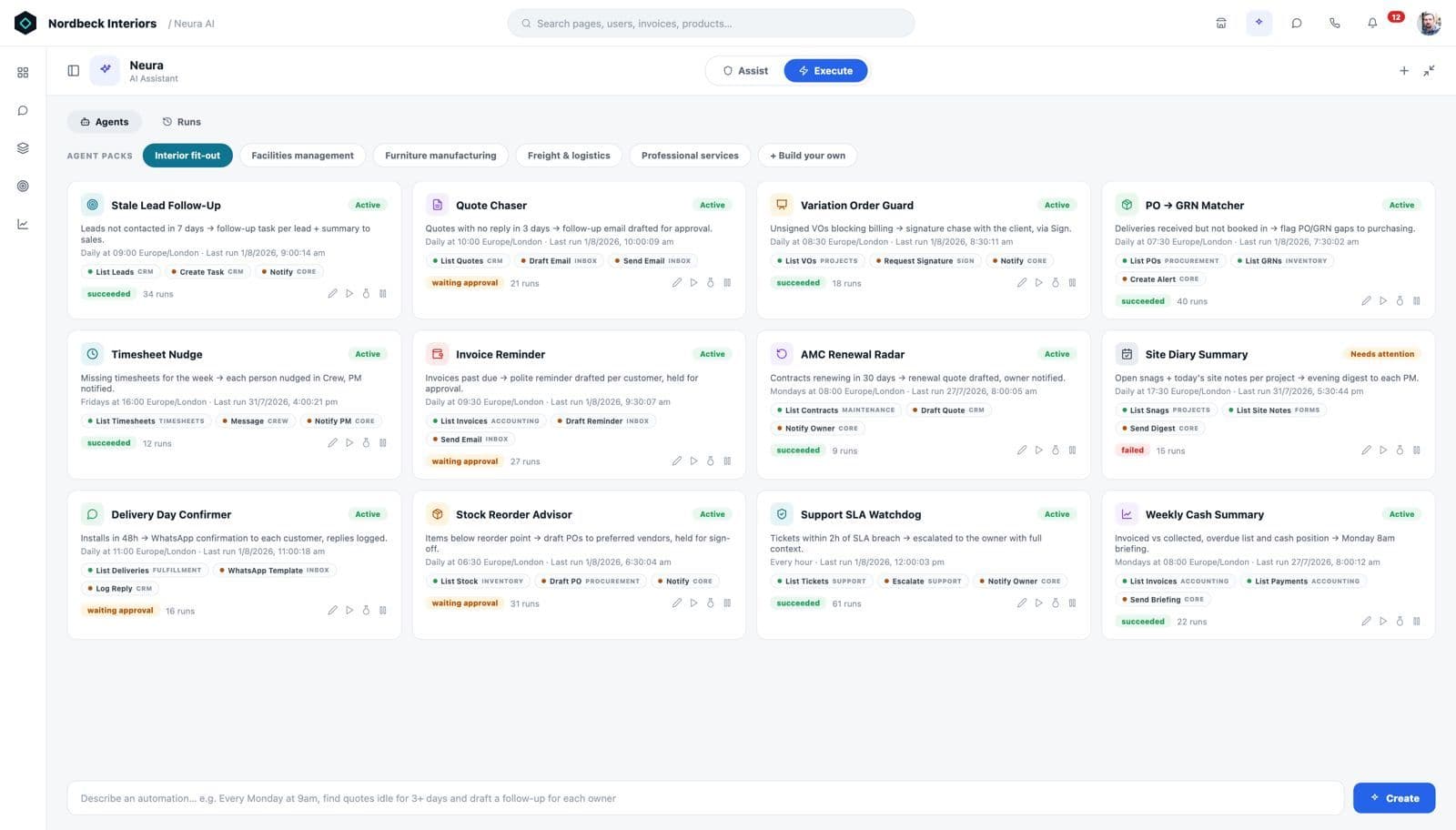
The capstone uses the same decision categories as the Neonbee platform: three-tier tenancy, module entitlements, cross-module workflows, and AI actions with approval and audit.
20+
Modules in the Neonbee platform
100k
IoT devices monitored live
15+ yrs
Telecom R&D and Big Tech
100+
Products and systems shipped
Instructor: Praveen VR
Ex-Dell Principal Engineer · Nokia & Alcatel-Lucent R&D · Founder, Moonhive & Neonbee AI
What you leave with
Artifacts, not notes.
Every deliverable is built during the program and reviewed. You can take it into a real review, a planning cycle, or a hiring conversation.
1
Architecture decision record set
Three decision records you can reuse in a real review: tenancy, boundaries, and frontend topology.
2
Module and ownership map
A boundary map with owners, contracts, and the integration style for each seam.
3
Tenancy and trust design
Isolation model, RLS approach, context propagation, permissions, and audit plan.
4
90-day architecture roadmap
A sequenced plan with reversible steps, decision checkpoints, and stakeholder milestones.
5
Mock board defense
A live defense with written feedback on clarity, trade-offs, risk, and executive framing.
6
Promotion narrative
A one-page story that connects your architecture work to team and business outcomes.
Format & investment
How it runs.
Training-only, by design
No code access, no PR reviews, no repository audit, no NDA, and no done-for-you implementation. You learn the pattern and build the artifact; your team keeps ownership.
Cohort pricing
Technical Leadership & Architecture
Request the current cohort sheet for tuition, employer sponsorship, and the next start date. Founding-cohort seats are limited.
Live instruction and review directly with Praveen VR.
All templates, artifacts, and session materials.
Employer sponsorship brief and itemised invoice.
Questions
Clear answers before you apply.
Still unsure? Send a note through the form and Praveen will give you a straight answer.
Is this a system design interview course?
No. It helps you think and lead like an architect, which also improves interview performance. The work is grounded in real architecture decisions, review boards, and delivery constraints — not interview puzzle patterns.
Do I need to be a team lead already?
No. The cohort is built for senior engineers who are close to the move and for new leads who need a repeatable decision framework. You should have 5+ years of professional engineering experience.
Do you review our production code?
No. This is training-only. All labs use representative case studies and your own design exercises. You do not need to share a repository, credentials, customer data, or an NDA.
How much time does it take each week?
Plan for two hours of live instruction, one hour of lab or review, and two to three hours of independent work. The capstone is built in small increments so it does not collide with a full-time role.
Will I get templates and materials?
Yes. You keep the decision-record templates, review agendas, boundary maps, capstone materials, and the working curriculum.
Can my employer pay for it?
If your employer supports learning and development, we provide a syllabus, an itemised invoice, and an employer sponsorship brief you can send to your manager.
Next step
Make the next step count.
Applications are reviewed personally. If the fit is right, you will get a short alignment call and a clear next step. If not, we will tell you.