For engineering teams modernizing a real platform
Modernize your platform without a rewrite — and make AI delivery safe.
A 3–5 day onsite or 2-week private online program for engineering teams of 10–20. Your team leaves with a target architecture, a delivery system, and a 90-day roadmap.
What you leave with
This is a training engagement, not an audit. We use your business context as the working material, teach the architecture and AI-delivery patterns, and leave your team with a plan they own.
3–5 days
Onsite option
2 weeks
Online option
10–20
Team size
Training-only
No code audit
Admissions
Request the program sheet & proposal
Tell us where you are and what you are trying to move forward. Every note is read personally. No lists, no sequence, no pressure.
Prefer the full working syllabus? Use the private curriculum request in the curriculum section. It is not published or indexed.
Engineering standards grounded in 15+ years at
Who this is for
Built for people who own the outcome.
This is not a survey course. The work assumes you have real decisions to make and can bring a current system, team, or delivery problem to the labs.
A fit if you are…
- Engineering teams of 10–20 with a growing or aging platform.
- CTOs, VPs of Engineering, architects, and tech leads who need a shared target architecture.
- Teams adopting AI coding tools without a verification and delivery system.
- Organisations that need a 90-day modernization roadmap, not a consulting report.
Not a fit if you want…
- Teams looking for a code audit, PR review, or repository access.
- Companies that want a vendor to implement the platform for them.
- Beginner bootcamps or general AI-awareness sessions with no architecture work.
What changes
What you will be able to do afterwards.
Create a shared map of current business flows, pain points, and constraints.
Define target module boundaries, tenancy, integration, and data ownership.
Prototype a shell, module contract, and event flow in a guided lab.
Install an AI delivery workflow with context files, agent roles, and verification gates.
Set up CI/CD, security checks, observability, and cost controls for AI-assisted work.
Present a sequenced 90-day roadmap to an executive review panel.
Curriculum
The work, day by day.
Each session produces a decision, a design, or a working slice. The capstone connects them into one architecture you can defend.
The private version includes weekly exercises, lab briefs, assessment rubrics, and the capstone checklist. It is not published or indexed.
Day 1Business systems map and current stateArtifact: Current-state systems map + constraint register
A structured workshop, not an audit. Your team maps how the business actually works today: revenue, work, data, systems, and the friction between them.
Day 2Target architecture and boundariesArtifact: Target architecture + boundary map
Move from symptoms to design. Your team defines target boundaries, ownership, tenancy, and integration rules — with explicit trade-offs and reversibility.
Day 3Platform labArtifact: Working platform slice + contract pack
A hands-on lab where your team builds a small but real slice: a shell, a module contract, a shared context, and one cross-module flow.
Day 4AI-native deliveryArtifact: AI delivery checklist + verification gate design
Install the delivery system that makes AI coding safe: repository context, agent roles, verification gates, CI/CD, security, and token economics.
Day 5Capstone and 90-day roadmapArtifact: 90-day roadmap + executive readout
Each team presents its target architecture, delivery plan, and first 90 days. The panel reviews trade-offs, risk, sequencing, and executive framing.
Production proof
Built for teams with a real system
The program is drawn from building and operating Neonbee's platform: 20+ modules, 10+ micro-frontends, roughly 60 deployable services, reusable CI workflows, self-hosted runners, blue/green deployments, and universal rollback. Your team works on its own architecture, not a fictional case.
The case used in the labs
The AI-delivery day is based on the same operating model used to run Neonbee: repo context, agent execution, verification gates, self-hosted CI, blue/green, and rollback across dozens of services.
20+
Modules in production
~60
Services deployed
5 days
Onsite immersion
90 days
Roadmap you leave with
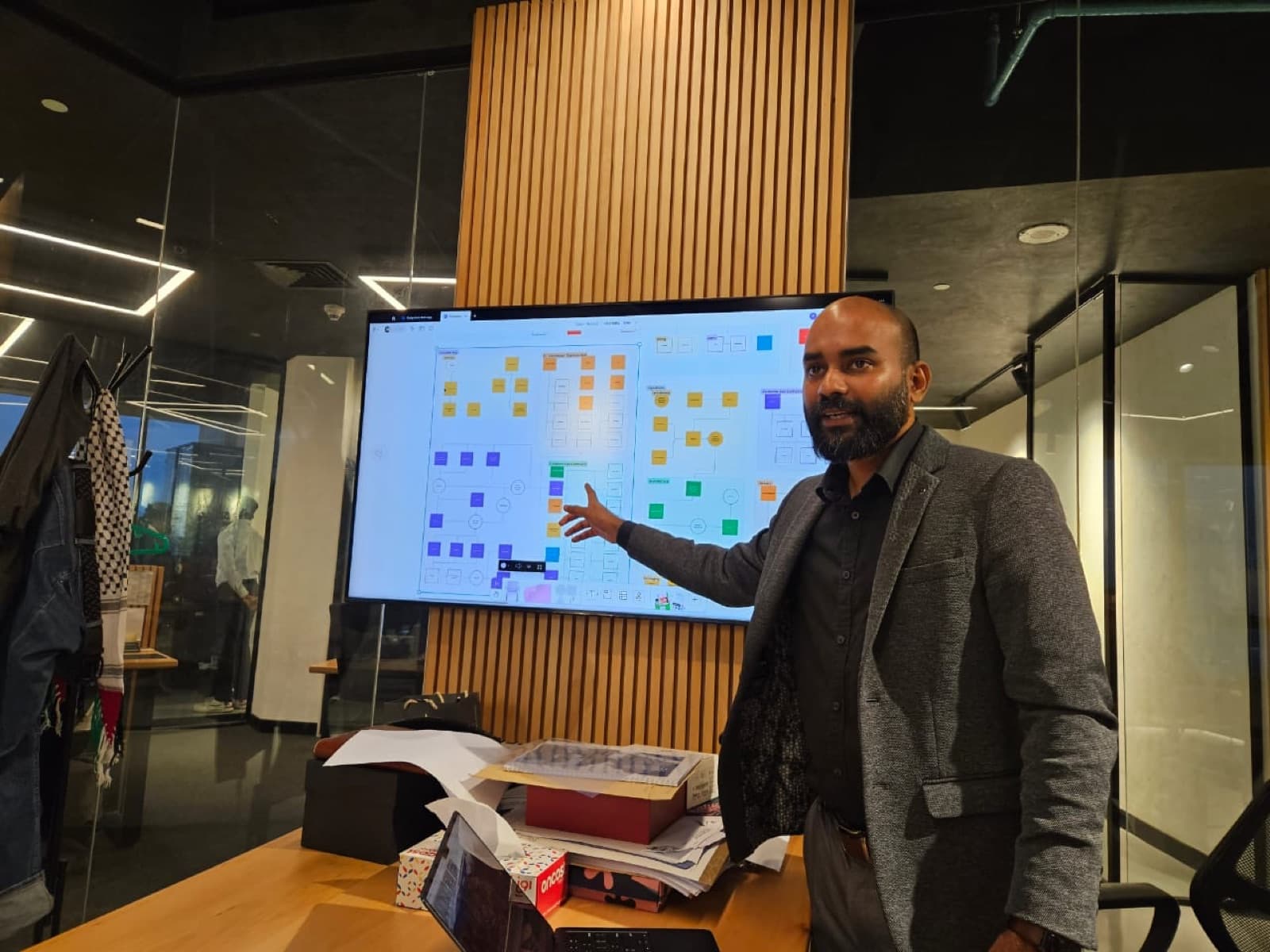
Instructor: Praveen VR
Ex-Dell Principal Engineer · Nokia & Alcatel-Lucent R&D · Founder, Moonhive & Neonbee AI
What you leave with
Artifacts, not notes.
Every deliverable is built during the program and reviewed. You can take it into a real review, a planning cycle, or a hiring conversation.
1
Current-state systems map
A shared view of business flows, systems, constraints, and delivery friction.
2
Target architecture
Boundaries, tenancy, data ownership, integration style, and explicit trade-offs.
3
Working platform slice
A shell, a module contract, shared context, and one cross-module flow.
4
AI delivery checklist
Context files, agent roles, verification gates, security, and cost controls.
5
90-day roadmap
Sequenced work with owners, decision checkpoints, and measurable outcomes.
6
Executive readout
A concise business case covering cost, risk, reversibility, and expected return.
Format & investment
How it runs.
Training-only, by design
No code access, no PR reviews, no repository audit, no NDA, and no done-for-you implementation. You learn the pattern and build the artifact; your team keeps ownership.
Custom team quote
Corporate Platform Engineering & AI Delivery
Pricing depends on format, team size, location, and preparation. Request a scoped proposal with syllabus, statement of work, and invoice.
Live instruction and review directly with Praveen VR.
All templates, artifacts, and session materials.
Employer sponsorship brief and itemised invoice.
Questions
Clear answers before you apply.
Still unsure? Send a note through the form and Praveen will give you a straight answer.
Is this a code audit?
No. It is a training engagement. We do not review your production code, take repository access, or produce a findings report. Your team maps its own context in guided workshops and builds in a sandbox.
Can you tailor it to our stack?
Yes. The architecture patterns are stack-agnostic, and the labs are adapted to your primary languages, frameworks, database, and CI environment during onboarding.
How many people can attend?
The program is designed for 10–20 people. Smaller teams can join a shared cohort; larger organisations can run sequential batches for different squads.
What do you need from us before the program?
A short context brief, the team roster and roles, and one or two business goals for the platform. We do not need code, credentials, customer data, or an NDA.
Onsite or online?
Both. The onsite format is 3–5 consecutive days. The online format is two weeks of half-day sessions with lab work between them. The content and deliverables are the same.
How is pricing structured?
Corporate pricing is a custom quote based on format, team size, location, and preparation. Request a proposal and we will send a scoped quote with a syllabus and statement of work.
Next step
Give your team a plan they own.
Applications are reviewed personally. If the fit is right, you will get a short alignment call and a clear next step. If not, we will tell you.